

The Future of News

Written by Bård Espen Hansen, VP Sales, Saga
First, some awesome news.
The New York Times just reported a 20% profit in 2025. The total revenue was 2.8 billion USD, out of which two billion was digital revenue. That’s a profit of 550 million USD. Which, by coincidence, is exactly the same as their current free cash flow. Nice.
So this means the news media business can be saved, right?
The short answer is yes. But do not fool yourself into thinking it will be easy. Because, as we all know, the news business is profoundly changing. And the survivors will be the ones capable of adapting.
Let’s start with the most basic of questions, the one being asked to journalism students on day one of class:
Why does independent journalism matter?
Because power, when left unobserved, tends to concentrate and, eventually, corrupt.
I come from Norway. For decades, we have considered ourselves the poster child of democracy. A transparent, non-corrupt, and honest society. Well, I’m embarrassed to say that the latest release of the Epstein files so far has probably had more severe consequences in Norway than almost any other country. Implicating:
-
- The Crown Princess
- A former prime minister, who went on to become Secretary General of the Council of Europe, and simultaneously head of the Nobel Peace Prize committee
- A former foreign minister, and the recently fired President of the World Economic Forum
- A former ambassador to the UN
- The former UN Special Coordinator for the Middle East Peace Process
Their connections to Jeffrey Epstein have prompted criminal investigations for aggravated corruption.
A direct consequence of independent journalism.
Second: A democracy is only as healthy as the information its citizens possess. If you don't know what’s happening, you cannot cast an informed vote or advocate for your own interests. An uneducated population risks electing a former reality TV star as president.
And third: One of the biggest threats to modern stability is fragmentation. When everyone gets their news from echo chambers, we lose a common floor of facts to debate upon.
The point is, without independent journalism, democracy is at stake. And when the funding of independent journalism is threatened, our way of life is under siege. That’s what keeps me up at night. That’s how serious the future of news is.

The Trump bump
Let’s stay with The New York Times for a second.
The major shift happened ten years ago, in 2016. The NYTimes observed that users began flocking to their app and website in far greater numbers than normal. After the 2016 election, the NYT saw an unprecedented surge in digital subscriptions. This was the first time they realized they didn't need to rely on Facebook or Google for traffic; people were seeking them out directly for accountability journalism.
So it’s all good then, great journalism is all it takes?
The answer is more complex.
Let us take a step back. Sorry for stating the obvious, but some context is needed. The upheaval in the media business was driven by two major technological innovations: YouTube in 2005 and the iPhone in 2007. This led to a shift in user behavior, which triggered traditional newspapers and broadcasters to begin dipping into each other's business models.
It didn’t happen overnight. During the first so-called multimedia era from 2006 to 2015, newspapers slowly began hiring video journalists to carry cameras, and broadcasters began hiring web writers to turn their TV scripts into articles. This was the period when traditional TV reporters looked down on their online colleagues as second-class journalists assigned to serve as secretaries, turning their precious TV news scripts into web articles.
And, I’m sad to say, to this day I still encounter broadcasters where the latter is true.
Then came the pivot to video. Since 2016, Facebook and other platforms have heavily promoted video, forcing every traditional newspaper to prioritize it. Simultaneously, broadcasters began building massive digital text teams to compete for the second screen – the phone in your hand while you watch TV.
Currently, we’re in the Personality and Platform stage.
- Journalists as creators: The NYT is encouraging its reporters to be video-first personalities, appearing in video documentaries and vodcasts.
- Broadcasters as publishers: The BBC’s text-based website is now one of the most-read newspapers in the world, despite never owning a printing press.
Why does it matter?
In 2016, linear TV still accounted for the vast majority of daily media time. And still, in 2026, both in the US and Europe, the 65+ age group continues to watch more than 5 hours of TV daily. But it is officially a minority habit among people under 65. For 16–24 year-olds, live TV viewing has dropped to as little as 20 minutes a day in markets like the UK.
And that’s all TV viewing. So what about the news?
In 2026, we have reached a historic crossover moment. For the first time, social media and video platforms have overtaken linear TV as the primary source of news for Americans. While the linear decline is happening on both sides of the Atlantic, the American and European markets are moving at different speeds due to the presence of strong public service broadcasters in Europe.
Approximately 54% of all Americans now get their news primarily via social media and video networks, officially surpassing TV news (50%) and even news websites/apps (48%).
But only about 19% of Americans under 30 follow the news all or most of the time. And when they do, it is almost exclusively via newsfluencers on TikTok and YouTube rather than traditional TV anchors. We’ll get back to that.
In Europe, as of early 2026, social media has officially overtaken all other news sources for Europeans aged 15–24.
TikTok is the fastest-growing news platform in Europe. In countries like Romania and Serbia, nearly a quarter of young people use it specifically for news.
The YouTube dominance
But despite the hype around TikTok, YouTube remains the heavyweight for depth. When measured by viewing time, YouTube is now watched more on big-screen TVs than on mobile devices. YouTube has evolved from a video site into the most influential news ecosystem on the planet.
This has real-life consequences. The BBC just announced that its YouTube strategy is pivoting to a massive "If you can't beat 'em, join 'em" approach. For two decades, BBC used YouTube merely as a marketing funnel—posting three-minute clips to try and lure viewers back to the BBC player.
As of January 2026, that model has been officially retired. The BBC now treats YouTube as a primary, first-run broadcast platform. This is a massive strategic bet for BBC – to publish their content where its users are. Their flagship YouTube channel, BBC News, is approaching 20 million subscribers. It’s also a financial decision. BBC is publicly funded and prevented from tapping into the ad market. Ad revenue from YouTube, however, is fair game.
BUT: Social media's impact on news is defined by a paradox. While some traditional institutions are finally mastering the platform, news Influencers are taking over the audience.
In the U.S., a fifth of the population now regularly gets news and commentary from podcasters like Joe Rogan. In France, news creator Hugo Travers, better known as HugoDécrypte, a French journalist and digital news creator, reaches 22% of the under-35 population, more than the digital reach of the country’s largest broadcasters.
The reason? The US continues to have some of the lowest trust in national TV news among Western nations, which has accelerated the shift toward personality-led commentary by specialized YouTube creators. And Europe is following suit.
Broadcasters are starting to take the shift seriously.
CNN’s Kaitlan Collins is the gold standard regarding post-cable news stars. While many of her peers still view social media as a place to simply post links to their TV segments, Collins treats non-CNN platforms as a primary stage for her journalism. Instead of waiting for her 9 PM primetime show, The Source, she breaks the news on social media first. She’s making on-the-fly vertical stand-ups tailored for Instagram and TikTok. This creates an authentic connection with younger audiences who find CNN's glossy studio lights too formal.
Collins has mastered the personality-led journalism that younger Europeans and Americans crave.
With combined followers approaching three million on Instagram and X, and a fast-growing TikTok presence on top of that, her personal reach often rivals the engagement of the official CNN accounts on specific political stories.
This positions her as an independent journalistic force who happens to work at CNN, rather than just a CNN employee.
Who do we trust?
Unlike the US, the most trusted news sources in Europe remain the digital portals of public broadcasters. Most of these brands have successfully transitioned their TV authority into dominant news apps.
But who is using the trusted brand-name apps?
In early 2026, the dominant news app user can be split into three distinct categories based on their age, education, and relationship with the brand.
The anchor loyalists. This group is the bedrock of public service broadcasting. For them, the news app is a digital extension of the evening news tradition. Typically aged 45 and older, with higher levels of formal education and stable incomes. Their relationship is rooted in long-term trust and historical habit, and they view the PSBs as a national utility.
The Verify Squad: This category represents the battleground for news brands. They are exhausted by the noise of social media and turn to trusted apps for clarity. Typically aged 25 to 45, urban, and highly tech-literate. Their brand relationship is functional. They don't necessarily feel loyal to the brand's tradition, but they value its accuracy.
The Incidental Digesters (The Passive Users): This is the youngest and most difficult group for broadcasters to capture. Under 25, heavily influenced by influencers and social algorithms. Their brand relationship is transactional and personality-led. They may follow a specific reporter on TikTok, but they might not even realize who the reporter works for. They enter the news app through side doors – clicking a deep link from a social post.
I know that CNN, NYT, and BBC might not feel relevant to everyone in this room. But let’s face it, they are the front-runners. What they do will, to some degree, serve as blueprints for the industry.
So let’s take a look at newsroom staffing.
The BBC currently employs approximately 5,500 journalists. The BBC’s approach to doing everything is a massive organizational shift into Digital First. But it isn't a simple case of every journalist holding a camera and a pen.
The majority of regional and national reporters are platform-neutral. A reporter covering a fire in Manchester is expected to file a short text update for the BBC News app, record a voice dispatch for Radio 5 Live, and provide a video clip for the evening news.
However, BBC still maintains a significant layer of platform-specific experts. You don't ask a world-class investigative text journalist to suddenly become a TikTok host, nor do you ask a live news anchor to spend three days writing a long-form 5,000-word essay. These specialists are the polish on top of the generalist output.
Still, out of the BBC's 5,500 journalists, 3,800, or roughly 70%, are multi-platform.
At the NYTimes, the approach is another.
While the BBC and the NYT are both thriving in 2026, their journalistic philosophies are quite different. If the BBC is moving toward the Multi-Skilled Generalist, the NYT is doubling down on the Integrated Specialist.
What it means, in short, is that when a big story breaks, a politics reporter doesn't just write an article. They are immediately joined by a visual journalist for graphics and an audio producer for The Daily. They work as a squad, a cross-functional team. This allows the reporter to stay a specialist in politics while the output becomes world-class across all formats.
On top of that, the NYT is currently on a massive hiring spree to add video-native journalists to its text-heavy reporting. The hiring strategy is focused on senior producers and video journalists who can act as one-man bands – reporting, shooting, and editing their own pieces. Their job is to follow traditional NYTimes reporters into the field and turn their expertise into high-quality vertical video for the app's Watch tab.
But the two publishing behemoths have one thing in common: the need to collaborate across skill sets to develop stories and publish different versions across various platforms.
The technology
And that brings us to technology. What kind of newsroom systems are needed to achieve what we want to do – collaborate – and the ability to publish to different platforms and audiences?
In 2026, the technology stack for a news organization no longer cares if you started as a newspaper or a broadcaster. To survive the total convergence, companies are moving toward a software-defined newsroom. This isn't just about buying better laptops; it’s about a fundamental shift from using tools to building an infrastructure that treats every story as a liquid asset.
For broadcast news, the transition to a software-defined newsroom is even more radical. It involves moving away from expensive, rigid hardware toward a flexible, IP-native infrastructure.
To achieve the multi-platform collaboration needed, a modern broadcast newsroom in 2026 relies on specific platforms to bridge the gap between TV people and digital people.
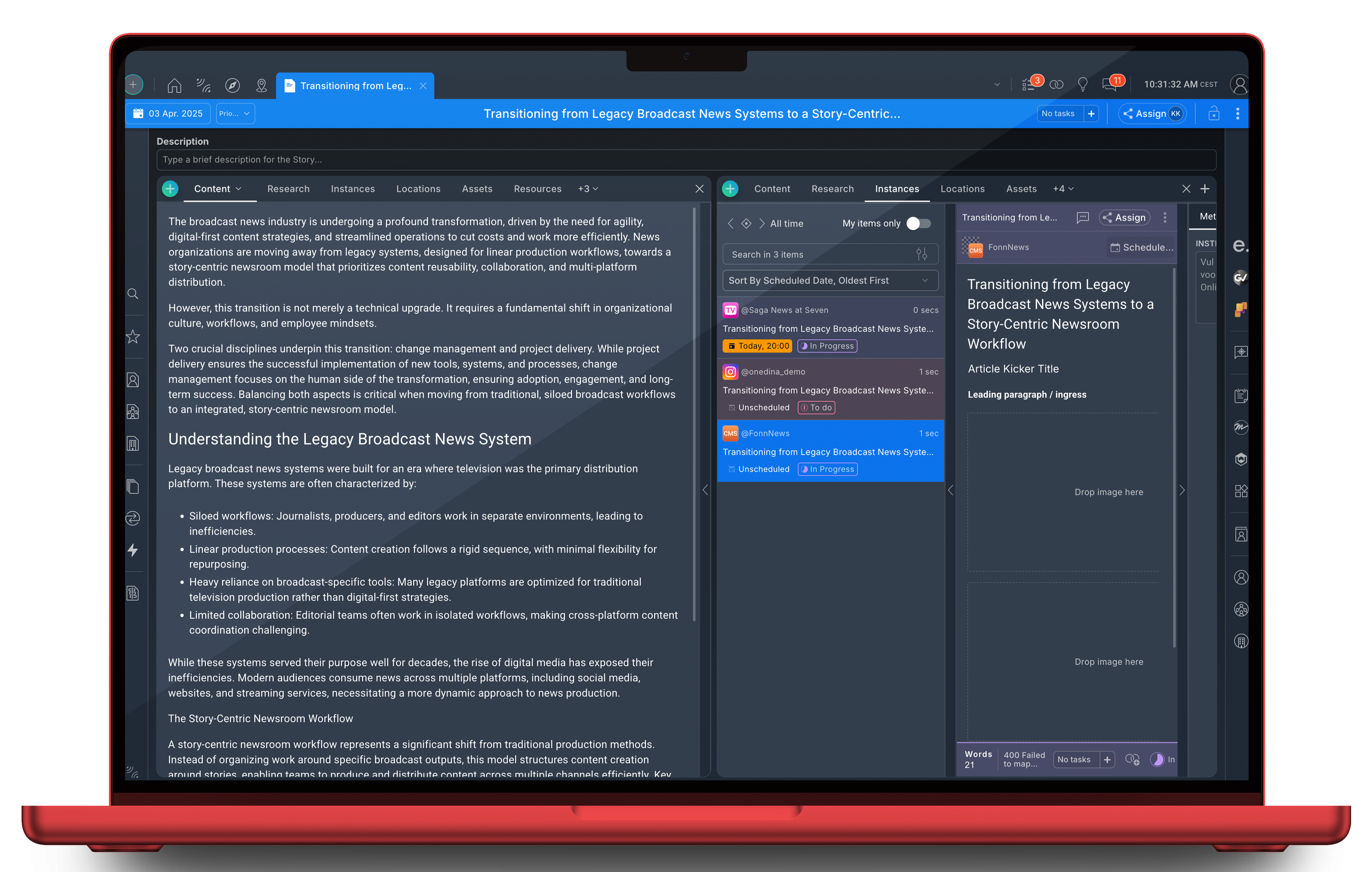
Historically, broadcast newsrooms were built around the TV rundown. In 2026, broadcasters are replacing legacy systems with story-centric platforms.
- The Master Story: Instead of creating a TV script and then a web article, a single master story container is created. This container holds all the facts, sources, and media.
- Collaboration in real-time: Much like a Google Doc, multiple specialists can work on that story simultaneously. While a reporter writes the lead, a social media editor is already extracting a quote for an Instagram post, and a producer is dragging the story into the 6 PM linear rundown.
- Platform agnostic: Such systems allow the newsroom to publish versions of the same story to a web CMS, social media platforms, and the linear broadcast gallery from one unified interface.
If the newsroom system contains the brain of the story, a modern cloud-native media asset management system is the memory and eyes that treat video as intelligent data rather than just heavy files.
- The needle in the haystack: Using advanced AI, modern MAMs automatically transcribe every second of video, recognize faces, and tag objects. If a broadcaster needs a clip of the Crown Princess talking about corruption, they don't search through labels; they search for the frame with the actual spoken words within the video.
- The proxy workflow: Broadcast-quality video is massive and hard to move. Modern systems create tiny proxy versions, 1-2% of the original size, that allow journalists to edit from anywhere: A café, a train, or a war zone, using just a browser, Adobe Premiere Pro, or DaVinci Resolve. The high-res footage stays in the cloud, ready for the final broadcast.
My point is:The era of silos is over.
In 2026, there is no such thing as a web writer or a TV reporter. There are only journalists. Success belongs to organizations like the BBC and NYTimes that have realized digital isn't a department, it's the atmosphere. Whether you use the multi-skilled generalist or integrated specialist model, the goal is the same: the story must be a liquid asset that flows wherever the audience lives.
Personality is the new masthead
Trust is migrating from faceless institutions to human beings. Whether it’s the newsfluencers on TikTok or stars like Kaitlan Collins, the audience – especially those under 30 – wants a guide, not a podium. Legacy brands must empower their journalists to be personalities without losing their institutional integrity. You don't just work for the brand anymore; you are the bridge to the brand.
Technology must be integrated
To keep up with the 24/7 social-first cycle, your technology cannot be a bottleneck. The software-defined newsroom isn't a luxury; it’s a prerequisite. If your systems still force a choice between the TV rundown and the web article, you are losing the race. You need a story-centric infrastructure that enables real-time collaboration so journalism can happen at the speed of thumb-scrolling.
The New York Times has proved that the business of news can be saved. But it wasn't saved by better printing presses or more expensive studios. It was saved by a radical willingness to change. We are no longer in the business of making TV shows or printing papers; we are in the business of maintaining the common floor of facts that democracy requires. The tools have changed, the platforms have shifted, and the faces have become more personal – but the mission remains the same.
The future of news belongs to those who stop protecting the past and start building the platforms that the next generation will trust.
Let’s get to work.
The author has worked in the media industry throughout his entire career and has experience in both print and TV, including 23 years as a journalist, TV news producer, editor, and head of the online news division at the leading Norwegian commercial broadcaster, TV 2.