Is story-centric just another buzzword? Or is it smart to organize the newsroom workflow around the story, rather than according to which platform it's going to be published to?
We’ve all been there. In a breaking news situation, it’s all hands on deck. Reporters from different parts of the newsroom are frantically working the phones to get info, often calling sources without knowing that a colleague in the other end of the newsroom has already conducted an interview with the same source.
The story-centric workflow Saga brings to the table represents a big step towards reducing the chaos, making different departments of the newsroom able to collaborate on the same story within the same tool, and then publish to any platform. Saga is especially useful when it comes to making broadcast and digital staff work as one unified team rather than detached from each other.
The old way
In broadcast news there used to be one platform; linear TV. When digital took its first modest steps into the newsroom, barebone digital staff were typically placed in the most remote corner, pretty much disconnected from the rest. Establishing digital alongside and not integrated with broadcast seemed to make sense. After all, the platforms are very different, and TV is king.
As the importance of digital news has increased, needs have changed. News that used to break on the big screen is now available on peoples phones long before being watched on TV. Time to market is more important than ever to stay relevant in today's hyper competitive environment.
Legacy workflows are not designed for the speed and collaboration required. Still, the way newsrooms are organized hasn't changed much. Staff from TV and digital are reporting simultaneously on the same stories, disconnected from each other. Sources keep wondering why they within minutes are being called and asked the same questions by different reporters from the same outlet. Reporters find themselves on location side by side with teams from one's own organization, gathering news on the same topic.
Saga drastically reduces this sub-optimal way of news production.
The master story
When a producer or editor is assigning journalistic resources to cover something newsworthy, a master story is created. It’s the key element of Saga.
- The master story serves as a hub where everyone contributes with the news gathering.
- When someone has interviewed a source, got hold of a video clip or a TV-crew has captured footage, the material is inserted into Saga. From here, everyone will have access to the material.
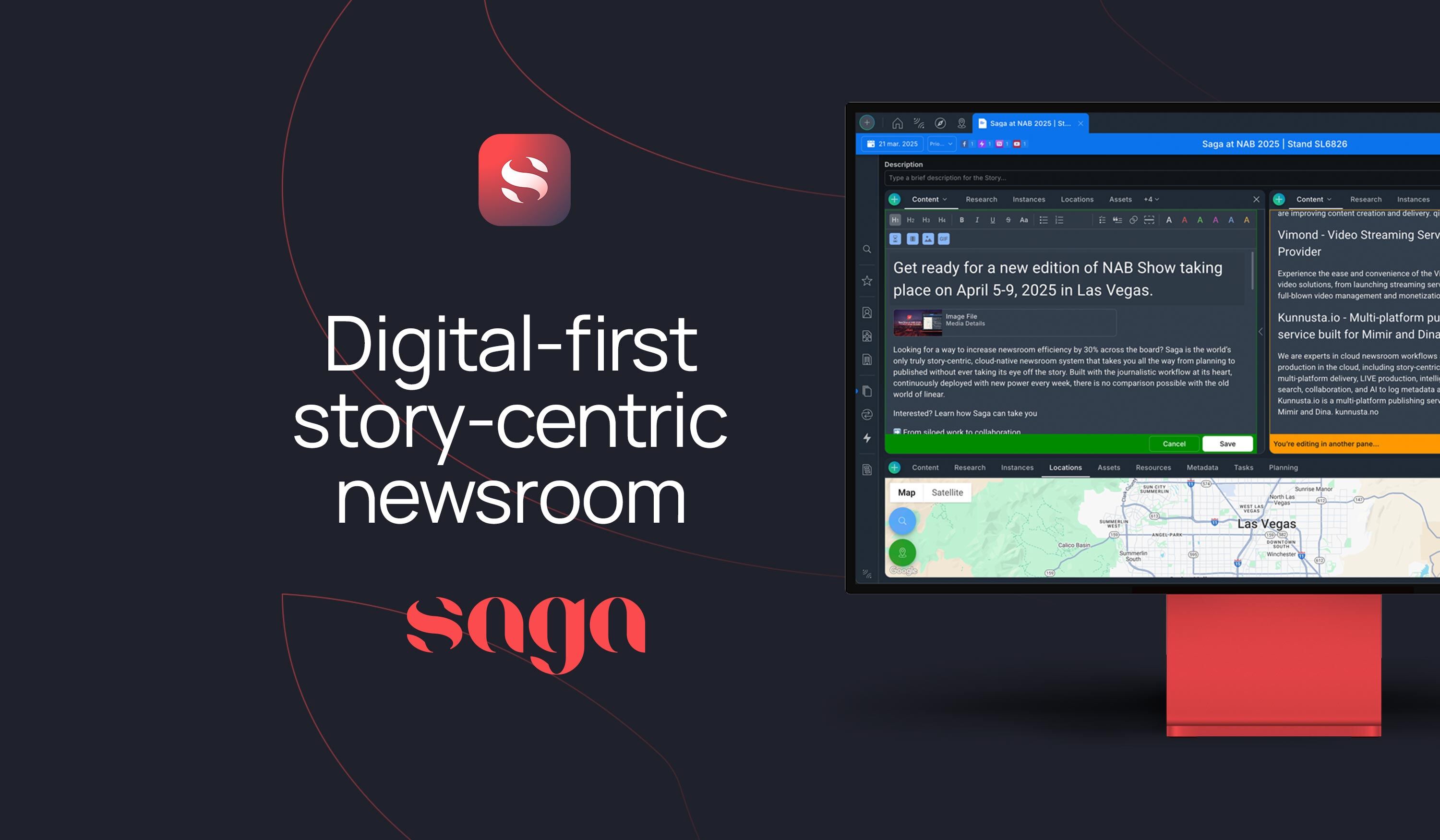
- Scripts for broadcast, articles for online and social media-posts can all be prepared within Saga, based on research and news gathering from different parts of the newsroom.
- From the master story you can publish to any platform; a linear rundown, OTT, web and social media.
If the master story originated from the digital department, a TV editor or producer can view the information and decide if a TV-crew or other additional resources should be assigned to the case. Likewise, digital reporters can be assigned to make an article for the web site or social version, based on material originated from a TV-crew.
Saga can of course be used as a rundown only tool. But the true power of Saga is unleashed when the story-centric approach is being utilized.
Want to learn more about story-centric workflows? Book a demo.